

Asile (DDS 鈥�08) and Asraa El-Darahali (DDS 鈥�13) are sisters, dentists and Dal alumni, graduating in 2008 and 2013 respectively. They鈥檙e also both committed community volunteers: last summer, they organised a 鈥淪pirit of Ramadan鈥� event to raise $15,000 for people in need in the Halifax area, followed by 鈥淐oats for Humanity鈥� at Thanksgiving, which saw 1,200 coats donated to local missions and charities.
But last November they took on a volunteer commitment of a whole different magnitude. They travelled to a Za鈥檃tari refugee camp near the Jordan-Syrian border, providing dental care for refugees fleeing the Syrian conflict. In a camp with 80,000 residents 鈥� half of them children 鈥� living in unsanitary conditions, the sisters worked in ill-equipped clinics, seeing 30-40 patients each day between them, working to make a difference against seemingly overwhelming odds.
鈥淵ou never hear on the radio how clinics in these camps are run, and what it is really like,鈥� says Asraa. 鈥淓very day we had to pass through a checkpoint to get in and out of the camp. There are two dental clinics for the whole camp. In the clinic where we worked, there were just two dental chairs, one of which was broken. Supplies were scarce. Tools were sterilized at the end of the day, so we used supplies until we ran out of instruments.鈥�
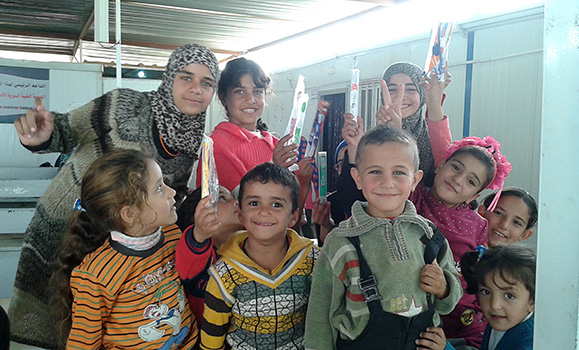
Children in the camp.
The journey to Jordan
Although as students they had volunteered at the North End Community Health Centre and for charities such as the Lung Association, both Asraa and Asile wanted the opportunity to travel to an area of great need to volunteer. When they heard about the Syrian American Medical Society (SAMS), they knew they had found the right group to work with.
In November 2015, Asile and Asraa flew to Amman, the capital city of Jordan, together with 45 other health professionals: GPs, nutritionists, gynaecologists, plastic surgeons and opthamologists. Some were first-timers, while others had made two or three trips to Za鈥檃tari.
 In the months leading up to the trip, Asraa and Asile fundraised and asked companies for donated supplies. Of the four suitcases they took with them, three were packed with gauze, gloves, syringes, local anaesthetic, amalgam, bibs, a handpiece, toothpaste and toothbrushes, as well as other supplies.聽 Their fundraising efforts brought in donations of $10,000 鈥� enough to buy a new dental chair and additional supplies for the camp.
Disaster nearly struck when they arrived in Jordan. Customs officials opened their bags and threatened to confiscate everything, despite an official letter from SAMS explaining who they were and the purpose of their trip. 鈥淲e were able to keep our supplies by lavishly praising the Jordanian king, whom the people admire,鈥� says Asraa.
"Children would come and hold our hands"
Each day began with a 45-minute to an hour鈥檚 journey from Amman to the camp. Asile and Asraa worked 8 a.m. to 3 p.m. Potential patients lined up each morning to get on the list to be seen that day. Once the list was full, anyone who was not on the list had to come back the next day and go through the process again.
鈥淲ar does not discriminate,鈥� says Asile. 鈥淲hether you are rich or poor, or had a profession before going into the camp, your life is no different from anyone else鈥檚.鈥�
And yet, in the face of so much upheaval and dislocation, separated families, and physical discomfort, Asile and Asraa found people who were grateful and happy to have them there.
鈥淭hey had so little, and yet they wanted to give,鈥� says Asile. 鈥淐hildren would bring us cards, cookies, and candy. We would skip rope with them and get invited to their houses for tea. Children would come and just hold our hands because we had taken away some of their pain.鈥�
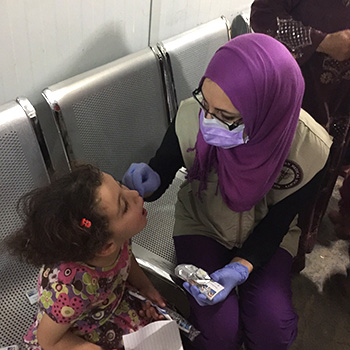 Many of the refugees had been in the camp for three years or more. A poor diet and the absence of toothbrushes and toothpaste had taken their toll. Much of the work Asile and Asraa (left) did was focused on relieving pain, often extractions.
With generator-supplied electricity, no suction and limited instruments, Asile and Asraa say that they became experts at extracting teeth with an elevator, a simple tool that expands the bone socket and allows a tooth to be levered out, using their headlamps for light. They repeatedly found themselves asking, 鈥渨hat is sensible and sufficient for this situation without compromising patient safety?鈥� Infection control was always on their minds. Asile says that working under those conditions made her a much better clinician.
Recalling their own experiences
Asile and Asraa immigrated with their family to Canada from Kuwait in 1992 in the wake of the Gulf War. Originally from Palestine, Kuwait soon became an impossible place for them to live and they knew they had to leave. They arrived in Halifax speaking no English and needing to learn a new way of life. They were grateful to be here, says Asraa, 鈥渂ut it was not until I met the refugees that I realized how much my parents struggled when they brought us here.鈥�
From their mother, the sisters learned to translate their feeling of gratitude into the quest to give back that has shaped their choice of profession and their volunteer activities. 鈥淥ur mother always says that whatever you give will come back to you,鈥� says Asraa, 鈥渘ot money or material things, but gratitude and happiness.鈥�
Would they go back to Za鈥檃tari? 鈥淚n a heartbeat,鈥� says Asile.
You can hear Asraa and Asile talk about their week in the Za鈥檃tari refugee camp and the importance of giving back to their community on Thursday, April 7 at 6 p.m.聽 in the Sir Charles Tupper Medical Building, Theatre B, 5850 College Street, Halifax. Admission is by donation (cash or cheque), with all proceeds going to support the and the . .