

Dal PhD student Zoya Tyabji was invited to be a keynote speaker at the world鈥檚 largest gathering of shark researchers this year, a conference that only happens once every four years.
Tyabi鈥檚 address at the 2026 in May offered a window into her work on shark and ray conservation in coastal India, research her doctoral supervisor characterizes as singular.
鈥淶oya鈥檚 work is unique in that it combines rigorous fieldwork with rigorous analytical work 鈥� quantifying things that are generally left as descriptive statistics rather than robust estimates,鈥� says her supervisor, Dr. Aaron MacNeil, who also 听held in Colombo, Sri Lanka.
Tyabji鈥檚 work isn鈥檛 just a by-the-numbers accounting of declining shark and ray populations in South Asia: it also considers the perspectives of local communities who see sharks and rays as commodities essential to their economic livelihoods.
The community鈥檚 wellbeing depends directly on whether they have fish to consume or trade, so it is important to include them in decision making and conservation.
鈥淚n India, the lives of fish and fishers have been long intertwined, with many coastal communities dependent on the species for food, culture, and as an economic means,鈥� says Tyabji, a Department of Biology doctoral researcher who grew up along India鈥檚 coast. 鈥淭he community鈥檚 wellbeing depends directly on whether they have fish to consume or trade, so it is important to include them in decision making and conservation.鈥�
Watch Tyabji鈥檚 presentation, 鈥淪hifting Cultures in Elasmobranch Conservation鈥� (elasmobranch is the technical term for sharks and rays which have skeletons made of cartilage rather than bone):
No easy answers
While India hosts over 170 species of sharks and rays and has been among the world鈥檚 top shark fishing nations since the 1950s, Tyabji says the Andaman Islands, an archipelago in the Bay of Bengal between India and Myanmar that鈥檚 a popular tourist spot for its coral reefs and crystal-clear water, was a 鈥渄ata-poor region鈥� for elasmobranchs.
To help close the gap, she conducted fish-landing surveys from 2017-2019, visiting sites where fishers unload their catch to document what species were found and when, and speak with fishers to better understand the socioeconomics of the industry.
Fish-landing surveys are 鈥渙ne of the most cost-effective and important ways to understand what elasmobranch species are fished and how they are used,鈥� Tyabji says. The information collected helps inform local management strategies and prioritize species and areas that require protection, though elasmobranch conservation remains 鈥渃omplex, nuanced, and politically sensitive.鈥�
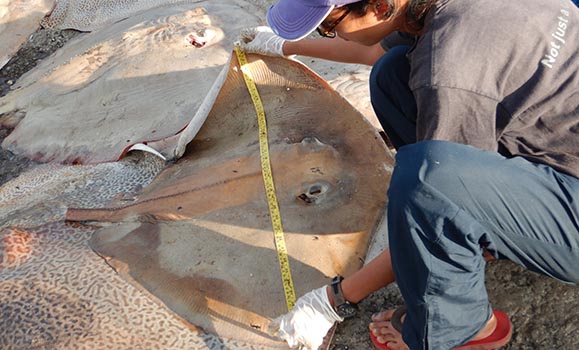
Zoya Tyabji measures a ray during a fish landing survey. (Dipani Sutaria photo)
As the final slide of her presentation notes, 鈥渟hark and ray conservation is related to human rights, power plays, and food security. Without understanding the system, conservation is doomed to fail.鈥�
鈥淎n incredible opportunity鈥�
Since joining Dal in 2021 to pursue a PhD, Tyabji鈥檚 focus has expanded from the Andaman Islands to exploring India鈥檚 broader role in the global shark and ray meat trade through Dr. MacNeil鈥檚 .听
鈥淶oya鈥檚 deep knowledge and experience in India are invaluable,鈥� says Dr. MacNeil. 鈥淲e simply could not have got a handle on this major player without her input.鈥�
He also praised the breadth of her work: 鈥淚 know of only one other researcher that does this at a globally relevant scale and they have 10 years鈥� more experience than Zoya. In the maturity and sophistication of her research at this stage of her career, she鈥檚 a pioneer.鈥�
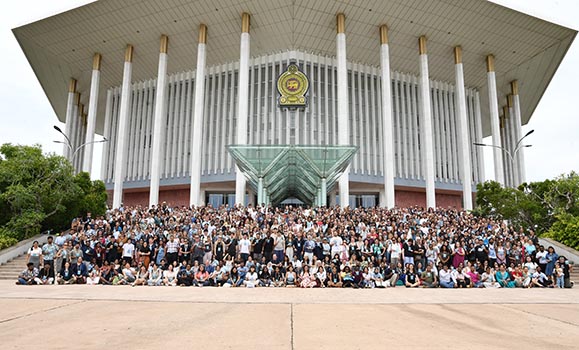
More than 850 participants from 60 countries gathered in Sri Lanka for the Sharks International conference in May. (Sharks International 2026 photo)
The 2026 Sharks International conference was the first to take place in Asia, making it a homecoming of sorts for Tyabji, not to mention helping reduce barriers to entry for South Asian attendees, who she noted can struggle with the cost and logistics of traveling to far flung global locations.
鈥淚t was an incredible opportunity to represent South Asia, network, view interesting research, and meet people, all in beautiful Sri Lanka,鈥� she says.